How to wear an Indian Saree - A Complete Step By Step Guide

(Viewed 9080 times since Jan 2000)

STEP 1


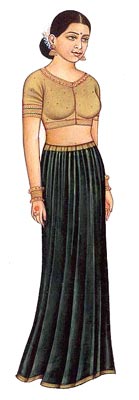
Two essential pieces of garments, that go alongwith the Sari, need to be chosen carefully to compliment the Sari. These are:

  • A petticoat - which is a waist-to-floor garment, tied tightly at the waist by a drawstring. The petticoat color should match the base sari color as closely as possible. No part of the petticoat, of course, is visible outside the Sari, after having worn it.

  • A blouse - which needs to be tight-fitting and whose color needs to be chosen keeping the look of the sari in mind, can be short sleeved or sleeveless, with a variety of necklines. The blouse ends just below the bust.

STEP 2


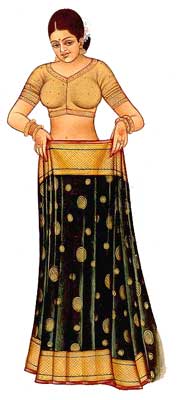
Start wearing the sari by tucking its plain/upper end into the petticoat, at a position which is a little bit to the right of the navel. Make sure that the lower end of the sari should be touching the floor, and that the whole length of the sari comes on the left-hand side. Now wrap the sari around yourself once, with the sari now coming back in the front, on your right side.

STEP 3


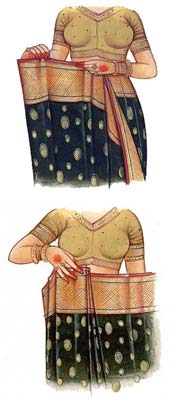
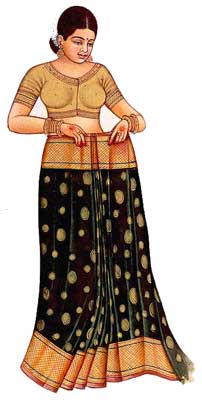
Make about 5 to 7 pleats of equal width of 5 inches, starting at the tucked-in end. Gather the pleats together, neatly, ensuring that the lower edge of the pleats are even and just off the ground and that the pleats fall straight and evenly. A safety pin may be used to stop the pleats from scattering.

STEP 4


Neatly tuck the pleats into the petticoat, at the waist, slightly to the left of the navel, in such a manner that they open to your left.

STEP 5


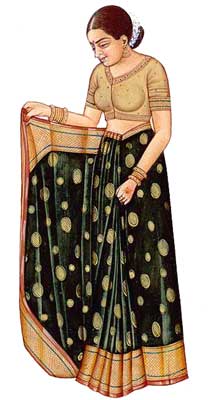
Drape the remaining fabric around yourself once more left to right, and bring it round your hips to the front, holding the top edge of the sari.

STEP 6


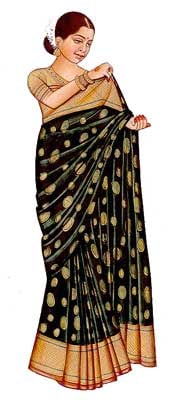
Slightly raise the remaining portion of the Sari on your back, bringing it up under the right arm and over the left shoulder so that the end of the Sari falls to about the level of your knees.

The end portion thus draped, from the left shoulder onwards, is called the Pallav or the Pallu, and can be prevented from slipping off teh shoulder, by fastening it at the shoulder to the blouse with a small safety pin.
Share Post:
Add a review

Your email address will not be published *

Popular Blogs
Shree Durga Saptashati - Meaning, Benefits, Path Vidhi, Chapters & Divine Significance
14 November 2023
Goddess Durga symbolizes power, courage, and all that the female energy is. She is the manifestation of the Adi Shakti and the protector of the universe from all evil. When the universe became burdened with the nuisance created by demons, the devas prayed to the Holy Trinity, i.e., Lord Brahma (the creator of the universe), Lord Vishnu (the preserver of the universe, and Lord Shiva (the destroyer of the universe).
Which God Idols should not be Kept at Home?
14 November 2022
Not all Hindu god idols are meant for household worship. Some require strict rituals, specific materials, and proper placement. Learn which deities to avoid at home, the importance of Vastu, and why damaged or fierce idols can disrupt spiritual balance. This guide outlines key iconography principles, suitable materials, and essential tips for choosing and worshipping idols in your Puja room for maximum positivity and divine blessings. Hindu religion allows the devotee the freedom to worship any deity they feel a personal connection (Bhakti) toward; however, picking the right idol for your home is a complex task. To understand the dos of picking a suitable idol of a Hindu god for your home, you should know a thing or two about which god idols should not be kept at home or what precautions should be taken when you are choosing an idol online for your Puja temple.
🕉️ Hindu Calendar 2026 – Tithis, Festivals & Auspicious Dates
1 January 2025
India is the land of many festivals and each of them holds a special place in the heart of its citizens. Out of the many cultures that coexist here, Hinduism is one and the most major. Let’s take a look at all the important festivals of the Hindu religion throughout the year.
Subscribe to our newsletter for new stories